Wednesday, September 28, 2011

signs, signs and more signs

My first visit to China was in 1979 (or thereabouts) when the freedom for the populace to dress as they wished was still some way off. Heating in stores was rare to non-existent and I remember being intrigued by doorway draught stoppers - they appeared to be entire skins from a bull or ox. They stopped the bitter wind blasting in to the Friendship Stores, (the main places for tourists to shop) but did nothing to keep out the cold.

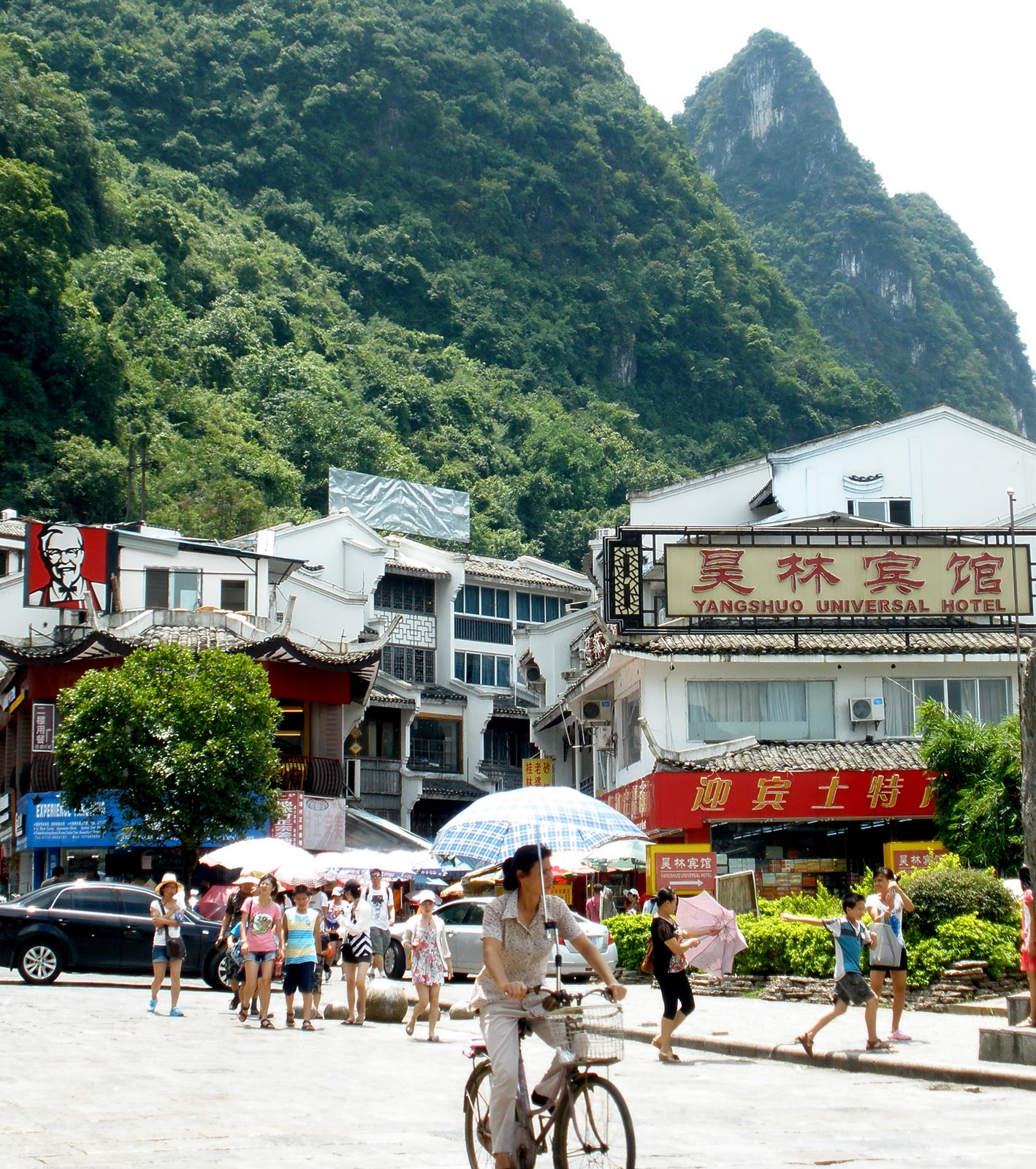
This photo was taken in Yangshuo where Colonel Sanders is dwarfed by the karst mountains. In the centre foreground,  a neatly dressed lady is meandering along on her bicycle with a sturdily attached umbrella. 


On the whole, vehicles of all types including those with motors and human powered ones appear to share the road and show tolerance towards each other.

Chinese music was the only type allowable, and propaganda announcements in trains were strident and intrusive. Neon lights were also rare, and Europeans were such a novelty that crowds gathered around to stare. To some extent, that still happens, but not so much in the major cities, although my husband was stopped frequently, even in Shanghai, for people to ask if they could have their photo taken with him - perhaps a taste of what it's like to be a celebrity! Amusingly, on the subway, people - young, older, men or women - would attempt to surreptitiously take his photo on the latest generation phone, which I found highly entertaining. I figured if ever I 'lost' him I'd just look for turning heads and whispered comments and follow the stares - I'd be sure to find him!

Why? Beards are hard for Asian men to grow, and my husband has a full beard, gone grey over the years which is seen by some to be a sure sign of wisdom.

A number of familiar western products are in the picture above. Others might have a familiar shape and colour, but be a uniquely local brand.
Sometimes as I trailed along behind my husband, taking photos, peering into laneways or daydreaming, an older man or woman would catch my eye and gesture as if they were stroking a beard, smile widely and give the thumbs up. I'd wink and smile - feeling very much like I was basking in reflected glory.

Of course back in the 70's and early 80's when China began opening up for tourism again after many years closed off, there was no advertising for Western products - in fact there was little obvious advertising at all, few neon lights in Beijing, and not overwhelming in Shanghai - the pace of change is something that really intrigues me. The things which were shunned so vehemently and seen as a corrupting influence have been embraced in the cities, and are commonplace and desirable.

Some logos are so well known, no words are needed at all.

Even if they're down a tiny alley, they'll be popular.
I think this is my favourite shot. The young lady, beautifully made up, wearing ultra short skirt and vicious stilettos, is checking via mobile phone where to meet her friend before she heads into KFC - the ultimate in fine dining?
Neon lights encourage shoppers till late in the evening.


Change ... How do you view it? A blessing, a curse, somewhere in between, or something entirely different?
.

Saturday, September 24, 2011

A Sign in China

Not signs as in OoooooooooooowwwwwwwwwooooOooooooo it's a sign about my destiny, mysterious kind of stuff, but the more mundane (or possibly not) billboard ones.

Pepsi billboard seen in Guilin.
Posters have been invaluable in the relatively recent era of Chinese History. During the time of Mao they were produced in their thousands to inform and mould the minds of the populace. The Shanghai Propaganda Poster Art Centre (link) has saved and displays hundreds of posters from that time. The posters provide an idealised account of the era, and gloss over the often dreadful experiences of everyday people.

I remember being taught some Chinese History at Primary School and hearing about the Great Leap Forward. But to see posters from that time and know that intellectuals were deemed enemies of the state and banished to remote, harsh areas to be forced to do manual labour and that famine was rife, shows that either our teachers were blind to what was really going on, or sanitised the reality to make the classes 'suitable' for Australian children. (No matter that their Chinese counterparts were living in misery unable to share their knowledge and lots of children had no access to education.)

Many posters show happy, smiling agricultural and industrial workers. The wording translates awkwardly, but the meaning is clear "March towards the top science" "More pigs for more fertilizer to obtain high yield grain". Communism was often depicted as like a happy garden with brightly clad, cheerful young women working in farmyards with not a speck of mud or dirt around - sanitised and glorified.

The wording on posters from the time of the Vietnam War makes fascinating reading, such things as:
"Support US black people's justice struggle", "Firmly support US people against US Imperialism invading Vietnam". It was a comparatively stable period politically, and artists were looking outward and able to express themselves more freely.

Given the sometimes acrimonious relationship with America, I find the billboard for Pepsi intriguing. The combination of a traditional propaganda poster - the strong, proud young people, oozing vitality, looking towards and saluting a glorious future - but clearly and unashamedly promoting an American product.

If you're visiting Shanghai and are interested in how propaganda posters were used during the Cultural Revolution, or if you simply enjoy poster-art, (the Shanghai Girl posters are a wonderful step back in time) do visit The Shanghai Propaganda Poster Art Centre. It's time well spent.

Where have you visited that you'd recommend? Why? What did you learn there?
.

Thursday, September 22, 2011

Stooks (or possibly sheaves) in China

Threshing the grain (at the left of the photo) using foot power
Little groupings of stooks (or possibly shaeves)
ready to be piled into larger mounds (possibly stooks).
I like stooks!

I like the word stooks, the way it rolls around in the mouth, the combination on letters almost mirroring the thing itself (possibly):

The taller t and k reflect the individual dried stalks propped upright, the oo is like the waist of the stook, belted neatly with fibre and the s's at each end are the fibre itself which has bound the stook to stand upright, independently and pertly in fields ready to be stacked into larger structures (I bet they have a cool name too - but if the big thing is the stook as Wikipedia seems to imply - I should have checked earlier - with the little ones being sheaves, then my whole story goes out the window! - except sheaf is a great word too - it just doesn't mirror as beautifully.)
I love the otherworldly look of stooks (and/or sheaves) populating higgledy-piggledy fields. Fields tucked in and shaped to fit into the natural contours of the land, handkerchief sized fields, human friendly and working with the landscape in a way we seem to have long forgotten. No doubt the work is backbreaking, hard, hot and sweaty, I’m not romanticising it, but it’s different to what I know; it looks right and fitting in this landscape – timeless, sustainable, workable.


Here, in Australia, massive tracts of land are pummelled by gigantic machinery, the driver perched way above in air-conditioned cab, barely able to see creatures, dragonflies or bees going about the important business of living, but vital nonetheless to the balance of life, fertilising flowers, ensuring crops thrive.
Photo: I. Travers
Near Guilin, our driver, Chen, and guide Li, were at first bemused by my excitement to see the stooks (or possibly sheaves) mentioned in childhood stories and depicted in old paintings. They later expressed pleasure in learning a new English word, obscure, rarely used, but accurate. Both were eager to go home and delve into dictionaries to learn more about the word’s derivation, history and usage. The following day they shared that the word appeared to originate in Germany, was then adopted in Scotland.

What a joy to teach and be taught about English words in a far off land; to share pleasure in words and play with sounds, to laugh together and wonder how did these words come about?

What words give you delight?
.

Sunday, September 18, 2011

Redundancy relived at Bushrangers Bay

Uneven sandy steps, well sheltered by dense tee tree hide the descent into Bushrangers Bay. I emerge suddenly onto rocks and the cold, yellow, gritty sand of the exposed beach.
Ozone is force fed into my stale air-conditioned lungs, stultified by recent work in gloomy buildings with sorrowful folk, the blustery wind whistles through my gold hoop earrings to energise my sludgy brain. Turbulent green waves crash, screaming their objection, obliterating all other noise and sending salt spray onto the washed out tussocky grass that clings precariously to the cliff edge, now battered by the increasingly steady wind.

Shadows cluster and obstruct the sun, which minutes before had been so welcoming, sapping the meagre warmth. T-shirt and shorts had seemed so sensible earlier; now, goose bumps are my body’s response to the afternoon chill. Seaweed, dried crispy brown, tumbles down the sand dune, gathers momentum, skitters, then flies back into the ocean to be pummelled relentlessly and finally disintegrate.
An hour or so respite, focusing on the senses, helps release the grip of fragmented snippets of conversation circling around my brain*.

Relive hearing deep male voices, tight with stress, unnaturally quiet for big blokes who work with steel and fire and water.

Confused voices, in pain; lost in a tangle of raw emotions they barely understand: grief, sorrow, loss, frustration and barely controlled anger and fear.
Redundancy is rarely nice - may evolve over time to something good, but I can’t help but think of the families in my community desperately trying to make sense of, and come to terms with their new reality.

270 people made redundant from a major local employer. I wonder how this will this play out over time for the men, their families and my community, and am grateful for the dramatic beauty and refuge of Bushrangers Bay.


*I'm assisting with the services provided to employees of BlueScope Steel (link) Hastings who have recently been made redundant.

.

Thursday, September 1, 2011

Yulong River near Yangshuo, China.

The area around Guilin is a popular holiday destination offering lots of typical as well as less common attractions.
Camel and pony rides
Some enterprising micro business-people had equipped themselves with digital cameras, computers and printers to capture the merriment and sell the prints for a modest fee.
Stalls set up on the breakwater
One husband and wife team had positioned themselves midway on the breakwater in the Yulong river near the Yangshuo Resort.  The prime position on the breakwater was where most rafts would need to stop for the passengers to disembark so that the raft could be pushed across the concrete ready to continue down the river. Any movement on the concrete needed to be undertaken carefully, as weed and slime was growing healthily in the clean water.
Rafts (complete with umbrellas) need to be pushed over the breakwater
to continue down the river.
Each morning this couple waded across the dangerously slippery concrete and through the flowing water pushing an elderly wooden cart containing the heavier items such as the computer and printer. A cheerful umbrella was erected at a jaunty angle to protect the electronics from the elements. The wife then paddled back to the riverbank near the village to collect the lighter items, camera and drinks while her husband began getting ready for the crowds that would soon float down, being punted by strong men. I couldn't work out how they powered the electronics, but they managed somehow.
Bicycle stall set up on the concrete bank.
Monkeys on the right dressed in gold costumes
and bright outfits for tourists to be photographed in.

Bamboo rafts pulled up at the bank ready to...
be loaded on to trucks to go back up the river to start again
with a new group of holiday-makers
After the fun, you can choose from a variety of cafes,
bars and restaurants for refreshments.
.

Tuesday, August 30, 2011

Li River - Guilin to Yangshuo

On the tourist route and loving it!

If you squint you can see a row of cormorants on a raft
(in the centre of the photo) waiting to work.
We were allocated a boat up the Li River with a large group of Italian tourists so being the only native English speakers on the boat, our guide seemed to spend the four hour trip scampering up and down decks to find us and point out particular notable scenic spots. Bless him, he also sped off with my camera during lunch to snap a particularly stunning curve in the river. For the Italians, it was their second to last destination on a two week package tour, and many were showing the exhausted signs of an intensely jam packed itinerary.
Impossible seeming shapes.
Soaking up the sublime scenery, many flopped in the seats, making the most of the opportunity to relax and chat. What a great opportunity to strike up a conversation! Thank goodness other countries acknowledge that it's important to learn more than one language. My sign language and pantomime sketches are adequate to communicate basically; but one of the many joys of travelling is having the opportunity to rub shoulders with people from around the world and  discuss world events, politics and compare outlooks.

Extraordinary mountains, seem to stretch forever.

How did such and such an event affect them? How was it reported there? What was the particular bias of their politicians? Did what we read in the papers and see on TV accurately reflect the event?  What a privilege we have being able to do this. I love the amazing conversations you have when bumping into someone from Brussels at breakfast,  Cologne at lunch and maybe London at dinner. Not to mention all the wonderful local Chinese people I met and conversed with.


The Li River is a very popular holiday destination.
 Not entirely surprisingly on the Li River, money was one topic that was raised. Not the cost of the boat ride, but the fact that this is where the sketch for the 20 Yuan note was done. A simple conversation starter could lead to show and tell about your own country's currency, how notes are impregnated with all sorts of metals and embossing to attempt to prevent forgeries, with a watermark here, a fine strip of metal there, a raised portion here for sight impaired people, and a particular compound placed just so, so that when the note is at just this exact angle it shimmers like a rainbow.
People power for washing dishes.
Best not to think that cold river water is used for the dishes.
The amazing topography is called Karst - a detailed description is here. Karst features are formed over hundreds of thousands of years from what was originally the seabed; but as the lands have changed the limestone has eroded and been uplifted producing extraordinary hills and mountains, underground rivers, caves of all shapes and sizes with awe-inspiring stalactites and stalagmites. Similar mountains are found in other regions of the world, but I am assured that China's Guilin area's claim to fame, is that the mountains cover the single largest region and extend south through to the Philippines and Indonesia. 
A fan souvenir and welcome refreshment at a local cafe.
The haze in the photos is a result of the extremely high humidity; fans are regularly used by men, women and children. Many are much larger than the souvenir 'gift' from the boat trip, and produce a welcome cooling breeze. I discovered (unintentionally) that sitting next to a vigorously fanning man and making "ahh" noises produced much hilarity and coy directing of the breeze on to my dripping face. Bless everyone who takes pity on a sweltering western woman!

.

Tuesday, August 23, 2011

Shanghai - beguiling, entrancing, captivating.

Grubby white sky, created by heat, smog or cloud, it doesn’t really matter which; lacks shape, interest and definition, like an unwashed sheep’s fleece blanketing this mega city, trapping the heat and humidity. No pure sunlight penetrates to create light and shade on earthly structures. A mono world, where dramatic architecture appears strangely shapeless and flat, all colour has been leeched out.
Futuristic and mundane on the riverfront.
The skyline comes into its own at night, colours are resurrected as dark descends, electronically and vibrantly enhanced, pulsating and energetic – unexpectedly entrancing, captivating. Gold ingots appear to stack perpetually, like an Aladdin’s cave unable to be emptied no matter how much gold is taken. One roof top structure, like a giant’s silver filigree crown, beautifully detailed, massive; oozes opulence and drama. Ladders of gems reach to the heavens being stacked and unstacked with frenetic activity, no need for words here, the symbolism crosses all language barriers!
Buddhist temple reflected in a massive skyscraper.
22 MILLION people (give or take a few), a similar number to the entire population of Australia resides and thrives in this city. Mind boggling, incomprehensible. But it works - appears to work well, like a perfectly oiled machine - to the outsider it seems efficient and runs smoothly.

TWENTY TWO million people: Han Chinese, minority groups, expats, transients from the world over, and of course, tourists, origamied into apartment blocks, hotels and dwellings which from the air look like a complex circuit board, laid out with efficient precision. Leafy lined avenues, lush and peaceful, modest homes and share housing with outdoor wash troughs men stripped to the waist, bathing (too intrusive to photograph) interspersed with opulent mansions and slick luxurious high rise apartments and offices. Rickety appearing, but solid old wooden homes, cheek to jowl with edgy futuristic architecture, demanding: “look at me”. So many styles; confusing in their diversity; jostling for space to breathe, a little room to stretch.

Old House Hotel and excellent Purple Onion restaurant
View from Old House Hotel, complete with ivy!
Street sleepers’ here - no different to Paris or Melbourne. Beggars too - mostly unobtrusive in their need, a low-key sign of a worldwide imbalance in wealth, of things not quite right. A darker side is here too, the dispossessed, ill, unwelcome people who also belong to any city, the flip side to all the apparent wealth and glamour.

I find this a beguiling city, full of complexity and contradictions. This pulsating metropolis seems comfortable in its own skin, firmly set with its roots in different times with different players vying for power, but clearly looking to the future. Historic buildings meander along the riverfront, some beautiful art deco, solid, steeped in history. Ferries full of excited visitors skitter across the river, thankfully avoiding container vessels and massive barges, reminders that this is a working river, not just a beautiful foreground for the eye-catching buildings.
The Bund
Postcard Shanghai with the Pearl Tower desperately trying to penetrate the grubby sky and find some blue, (it must be up there somewhere). The flagship Apple store all reflecting shine and squeaky clean glass, Super Brand Mall housing the kind of brands where price-tags are discretely hidden from view. Where the air-conditioned ambience seems to be more opulent than elsewhere - a blessed relief from the relentless drippy heat and humidity.
Apple store and Pearl Tower
Reflections shimmer on the Apple
Family groups gather on The Bund, promenade, slurping frozen treats – mung beans or peas are very popular, as well as what we think of as more traditional mango and fruit flavours.

Traffic, which at first seems to be a muddle of cars, taxis, bicycles, electric motorbikes and men pulling carts laden with painfully heavy loads settles into a pattern, a dance of weaving elegance and tolerance. Perhaps there’s an awareness or acceptance that to house such a huge population, arrogant aggression and selfish road rage have no place - would upset the delicate balance. Against all odds it works, and I feel envious of a culture where ‘giving the finger’ and vicious, ugly and profane words and phrases are not part and parcel of one’s daily driving experience.
The old and new.
I’m also envious of the subway - cheap, efficient, and oh so easy to navigate! Melbourne, are you listening? Why can’t we get public transport right? And wifi? Our antiquated system, outrageously expensive, is positively archaic – How wonderful that I can sit in a café in Shanghai, enjoy an excellent coffee, and communicate easily via email with friends around the world (as long as I don’t want to use Facebook or look at a Blog – but that’s a can of worms I won’t open) but shamefully, free wifi is not commonplace in Melbourne cafes and is an additional expense in many Australian hotels.
Low rise streetscape and umbrellas always ready
for rain or shine!
Odd being a lone foreign woman walking, it feels safe though, there’s no nasty edge, smartraveller.com is worth a look for the common scams. One takes care and doesn’t put oneself in harms way. Not enough time, sadly, to do a walking tour to discover the history of Jews seeking sanctuary here. But the Propaganda Poster Museum is fascinating, secreted away in the basement of a building, no signage at all - word of mouth is a wonderful thing amongst travellers!
Leafy lined boulevard in The French Concession -
note the lady with the umbrella on her electric scooter.


.

Thursday, August 4, 2011

on Hong Kong, Macau and China


Torrential rain in Hong Kong
I hadn't expected to see Snoopy on a petrol cap in mainland China!
 Dragon Fruit

It's easy to forget that Portugal had control over Macau until very recently. According to Wikipedia, trading between Portugal and China began well before the 1500's when a trading base was established, with  Portuguese traders being allowed to anchor ships in Macau's harbors and carry out trading activities, but they weren't allowed to stay onshore. 

Around 1552, the Portugese obtained temporary permission to erect storage sheds onshore, in order to dry out goods drenched by sea water. It wasn't until later that the Portuguese established a permanent settlement in Macau.  China retained sovereignty and Chinese residents were subject to Chinese law, but the territory was under Portuguese administration. All of which sounds like a real headache for everyone.

The architecture has a distinctly non Chinese feel.
Old and new in Macau. 
 
Warrior protecting a casino
 Elephant tusk? Exquisite, intricate carving.

During the 16th century, Macau also served as a trafficking point for Chinese slaves to Portugal. Many Chinese boys were captured in mainland China, and were brought, via Macau to Portugal, where they were sold as slaves. Some were on-sold in Brazil, which was a Portuguese colony. Chinese slaves were prized by the Portuguese and regarded better quality than slaves from other countries.

The Portuguese retained control over Macau until 1979. Eventually, the stage was set for the return of Macau to full Chinese sovereignty as a Special Administrative Region in 1999. (As is Hong Kong)

The PRC has promised that, under its “one country, two systems” formula, China's socialist economic system will not be practiced in Macau and that Macau will enjoy a high degree of autonomy in all matters except foreign and defense affairs until at least 2049, fifty years after the handover.

All of which is a long way of getting around to saying that the custard tarts are fantastic, and may well come from a Portuguese recipe.
Portuguese Egg Tarts @ KFC

*I'll be in China for the next couple of weeks, and due to their restrictions will be unable to access Blogger, or visit and comment on other blogs. But I promise I'll think of the blogosphere each time I munch on a custard tart!

Information on Macau here, however re visas, it's important to know that if you travel to Macau from mainland China and wish to return to mainland China, you'll need a double entry visa.

.