Showing posts with label posters. Show all posts

Wednesday, September 28, 2011

signs, signs and more signs

My first visit to China was in 1979 (or thereabouts) when the freedom for the populace to dress as they wished was still some way off. Heating in stores was rare to non-existent and I remember being intrigued by doorway draught stoppers - they appeared to be entire skins from a bull or ox. They stopped the bitter wind blasting in to the Friendship Stores, (the main places for tourists to shop) but did nothing to keep out the cold.

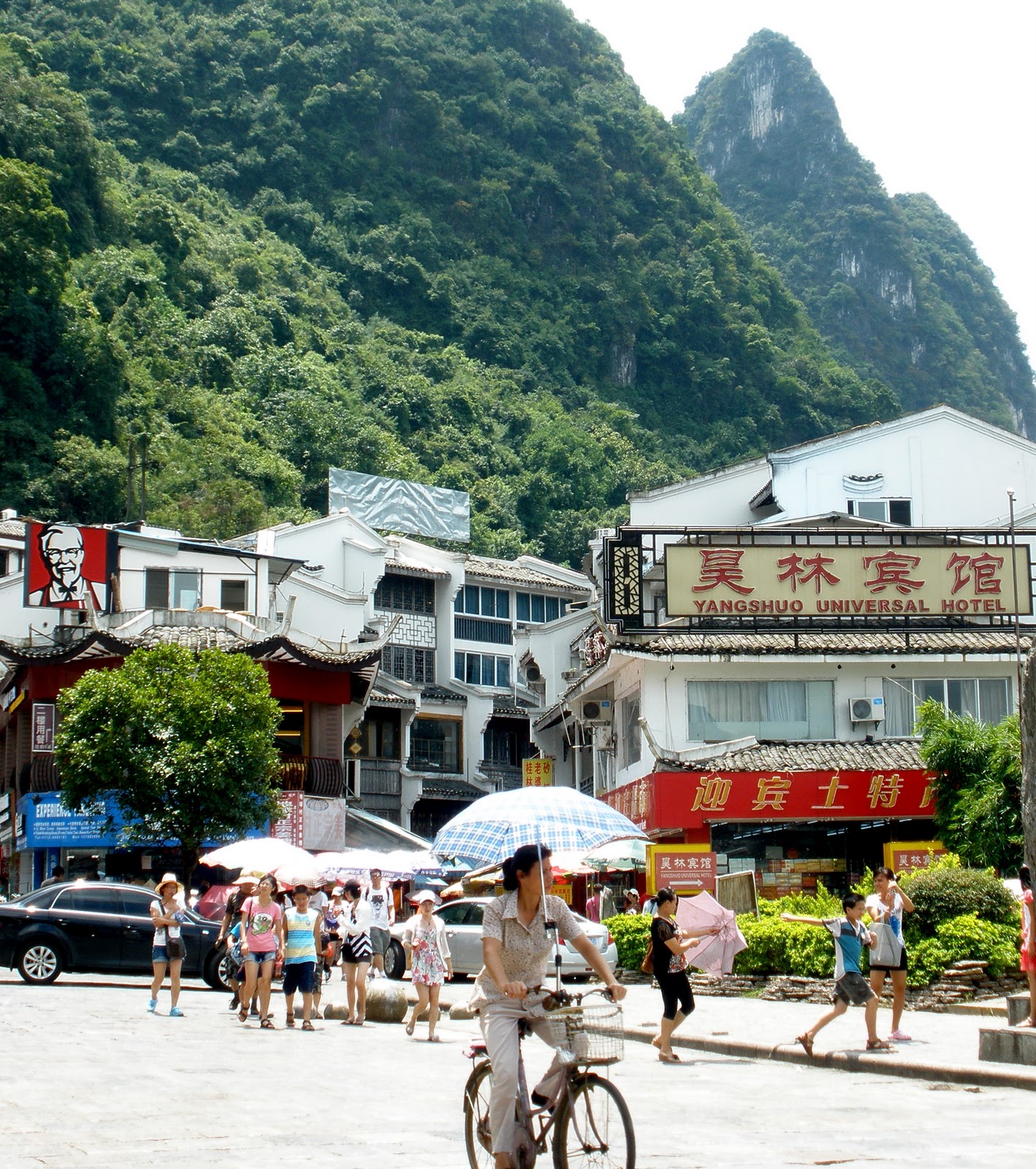
This photo was taken in Yangshuo where Colonel Sanders is dwarfed by the karst mountains. In the centre foreground,  a neatly dressed lady is meandering along on her bicycle with a sturdily attached umbrella. 


On the whole, vehicles of all types including those with motors and human powered ones appear to share the road and show tolerance towards each other.

Chinese music was the only type allowable, and propaganda announcements in trains were strident and intrusive. Neon lights were also rare, and Europeans were such a novelty that crowds gathered around to stare. To some extent, that still happens, but not so much in the major cities, although my husband was stopped frequently, even in Shanghai, for people to ask if they could have their photo taken with him - perhaps a taste of what it's like to be a celebrity! Amusingly, on the subway, people - young, older, men or women - would attempt to surreptitiously take his photo on the latest generation phone, which I found highly entertaining. I figured if ever I 'lost' him I'd just look for turning heads and whispered comments and follow the stares - I'd be sure to find him!

Why? Beards are hard for Asian men to grow, and my husband has a full beard, gone grey over the years which is seen by some to be a sure sign of wisdom.

A number of familiar western products are in the picture above. Others might have a familiar shape and colour, but be a uniquely local brand.
Sometimes as I trailed along behind my husband, taking photos, peering into laneways or daydreaming, an older man or woman would catch my eye and gesture as if they were stroking a beard, smile widely and give the thumbs up. I'd wink and smile - feeling very much like I was basking in reflected glory.

Of course back in the 70's and early 80's when China began opening up for tourism again after many years closed off, there was no advertising for Western products - in fact there was little obvious advertising at all, few neon lights in Beijing, and not overwhelming in Shanghai - the pace of change is something that really intrigues me. The things which were shunned so vehemently and seen as a corrupting influence have been embraced in the cities, and are commonplace and desirable.

Some logos are so well known, no words are needed at all.

Even if they're down a tiny alley, they'll be popular.
I think this is my favourite shot. The young lady, beautifully made up, wearing ultra short skirt and vicious stilettos, is checking via mobile phone where to meet her friend before she heads into KFC - the ultimate in fine dining?
Neon lights encourage shoppers till late in the evening.


Change ... How do you view it? A blessing, a curse, somewhere in between, or something entirely different?
.

Saturday, September 24, 2011

A Sign in China

Not signs as in OoooooooooooowwwwwwwwwooooOooooooo it's a sign about my destiny, mysterious kind of stuff, but the more mundane (or possibly not) billboard ones.

Pepsi billboard seen in Guilin.
Posters have been invaluable in the relatively recent era of Chinese History. During the time of Mao they were produced in their thousands to inform and mould the minds of the populace. The Shanghai Propaganda Poster Art Centre (link) has saved and displays hundreds of posters from that time. The posters provide an idealised account of the era, and gloss over the often dreadful experiences of everyday people.

I remember being taught some Chinese History at Primary School and hearing about the Great Leap Forward. But to see posters from that time and know that intellectuals were deemed enemies of the state and banished to remote, harsh areas to be forced to do manual labour and that famine was rife, shows that either our teachers were blind to what was really going on, or sanitised the reality to make the classes 'suitable' for Australian children. (No matter that their Chinese counterparts were living in misery unable to share their knowledge and lots of children had no access to education.)

Many posters show happy, smiling agricultural and industrial workers. The wording translates awkwardly, but the meaning is clear "March towards the top science" "More pigs for more fertilizer to obtain high yield grain". Communism was often depicted as like a happy garden with brightly clad, cheerful young women working in farmyards with not a speck of mud or dirt around - sanitised and glorified.

The wording on posters from the time of the Vietnam War makes fascinating reading, such things as:
"Support US black people's justice struggle", "Firmly support US people against US Imperialism invading Vietnam". It was a comparatively stable period politically, and artists were looking outward and able to express themselves more freely.

Given the sometimes acrimonious relationship with America, I find the billboard for Pepsi intriguing. The combination of a traditional propaganda poster - the strong, proud young people, oozing vitality, looking towards and saluting a glorious future - but clearly and unashamedly promoting an American product.

If you're visiting Shanghai and are interested in how propaganda posters were used during the Cultural Revolution, or if you simply enjoy poster-art, (the Shanghai Girl posters are a wonderful step back in time) do visit The Shanghai Propaganda Poster Art Centre. It's time well spent.

Where have you visited that you'd recommend? Why? What did you learn there?
.